Chapter 2 — Porting Recipe: GGUF to CoreML ANE
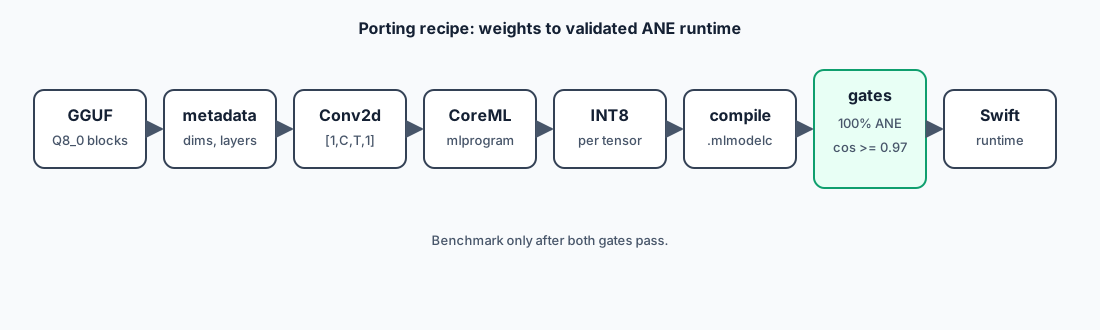
This chapter walks you through converting a model from GGUF to a set of ANE-resident CoreML shards, from scratch. We use Qwen 2.5 as the worked example but the pattern applies to any dense transformer.
Porting means preserving the model’s math while changing its representation. The
original checkpoint describes transformer weights and tensor operations in the
format used by a training or CPU/GPU inference stack. The ANE version must expose
the same projections as CoreML mlprogram operations, with 4D tensor shapes,
compiled artifacts, residency checks, and numerical goldens.
The goal is not merely to produce a .mlmodelc. A compileable model can still be
wrong, slow, or CPU-bound. The port is finished only when the graph is resident on
ANE and its outputs match a trusted reference closely enough to benchmark.
Prerequisites
- macOS 15+ (Sequoia), Apple Silicon Mac
- Xcode 16+ (the bundled
python3has coremltools 9) - A GGUF file from Hugging Face (
.Q8_0.ggufrecommended)
Three Python environments, never mixed:
| Env | Use case | Activate |
|---|---|---|
.venv |
PyTorch, training, golden capture | source .venv/bin/activate |
.venv313 |
HuggingFace / transformers | source .venv313/bin/activate |
Xcode python3 |
coremltools 9, CoreML conversion | /usr/bin/python3 (Xcode) |
Never run coremltools from .venv or .venv313 — they have coremltools 8 or
older. Conversion must use Xcode’s python3.
Step 0: Read the GGUF and Extract Metadata
# converters/gguf_to_ane.py (the generic converter)
from gguf import GGUFReader

reader = GGUFReader("model.Q8_0.gguf")
arch = reader.fields["general.architecture"].data[0]  # e.g. "qwen2"
n_layers = int(reader.fields[f"{arch}.block_count"].data[0])
d_model = int(reader.fields[f"{arch}.embedding_length"].data[0])
n_heads = int(reader.fields[f"{arch}.attention.head_count"].data[0])
n_kv_heads = int(reader.fields[f"{arch}.attention.head_count_kv"].data[0])
n_ff = int(reader.fields[f"{arch}.feed_forward_length"].data[0])
vocab_size = int(reader.fields[f"{arch}.vocab_size"].data[0])
GGUF quantized weights are stored as Q8_0 blocks (32 values per block, each
block has a float16 scale). You must dequantize to float32 before building the
CoreML graph.
Step 1: Build the Conv2d Model Graph
The key insight (Chapter 0): every nn.Linear becomes nn.Conv2d(in, out, 1×1).
Reshape input from [T, d] → [1, d, T, 1] at the start, back at the end.
import torch
import torch.nn as nn

class ANETransformerLayer(nn.Module):
    def __init__(self, d_model, n_heads, n_kv_heads, d_ff, d_head):
        super().__init__()
        # All projections as 1x1 Conv2d
        self.q_proj = nn.Conv2d(d_model, n_heads * d_head, 1, bias=False)
        self.k_proj = nn.Conv2d(d_model, n_kv_heads * d_head, 1, bias=False)
        self.v_proj = nn.Conv2d(d_model, n_kv_heads * d_head, 1, bias=False)
        self.o_proj = nn.Conv2d(n_heads * d_head, d_model, 1, bias=False)
        # FFN
        self.gate_proj = nn.Conv2d(d_model, d_ff, 1, bias=False)
        self.up_proj   = nn.Conv2d(d_model, d_ff, 1, bias=False)
        self.down_proj = nn.Conv2d(d_ff, d_model, 1, bias=False)
        # Norms
        self.norm1 = RMSNorm(d_model)
        self.norm2 = RMSNorm(d_model)

    def forward(self, x):
        # x: [1, d_model, T, 1]
        h = self.norm1(x)
        # Attention (simplified, non-stateful for illustration)
        q = self.q_proj(h)  # [1, n_heads*d_head, T, 1]
        k = self.k_proj(h)
        v = self.v_proj(h)
        # ... reshape, RoPE, attention, o_proj ...
        x = x + attn_out
        h = self.norm2(x)
        gate = torch.nn.functional.silu(self.gate_proj(h))
        up   = self.up_proj(h)
        x    = x + self.down_proj(gate * up)
        return x
Step 2: Load Weights from GGUF
def load_layer_weights(reader, layer_idx, model):
    """Dequantize GGUF Q8_0 weights and load into Conv2d model."""
    prefix = f"blk.{layer_idx}"
    for name, param in model.named_parameters():
        gguf_key = gguf_key_map(prefix, name)  # map conv weight names → GGUF keys
        tensor = reader.tensors[gguf_key]
        weights_f32 = dequantize_q8_0(tensor)   # float32
        # Conv2d weight shape: [out, in, 1, 1]
        param.data = torch.from_numpy(weights_f32).reshape(param.shape)
Q8_0 dequantization: each block of 32 values has a float16 scale.
import numpy as np

def dequantize_q8_0(tensor):
    data = tensor.data  # raw bytes
    n_blocks = len(data) // 34  # 2 bytes scale + 32 bytes ints
    data = data.reshape(n_blocks, 34)
    scales = data[:, :2].view(dtype=np.float16).reshape(-1, 1).astype(np.float32)
    ints   = data[:, 2:].astype(np.int8).astype(np.float32)
    return (ints * scales).reshape(-1)
Step 3: Trace and Convert to CoreML
import coremltools as ct

# Trace with example input (T=1 for decode, T=4 for RangeDim)
example_input = torch.zeros(1, d_model, 4, 1)
traced = torch.jit.trace(layer_model.eval(), example_input)

# Convert to CoreML mlprogram targeting ANE
coreml_model = ct.convert(
    traced,
    inputs=[ct.TensorType(name="hidden", shape=[1, d_model, ct.RangeDim(1, 4), 1])],
    outputs=[ct.TensorType(name="out_hidden")],
    convert_to="mlprogram",
    minimum_deployment_target=ct.target.macOS15,
    compute_units=ct.ComputeUnit.CPU_AND_NE,
)
ct.RangeDim(1, 4) tells CoreML the sequence dimension T can be 1–4 at runtime.
This enables speculative decode (Chapter 6) without recompiling.
Step 4: Apply INT8 Quantization
op_config = ct.optimize.coreml.OpLinearQuantizerConfig(
    dtype=ct.optimize.coreml.QuantizationDtype.int8,
    granularity="per_tensor",  # NOT per_block — see Chapter 3
)
config = ct.optimize.coreml.OptimizationConfig(
    global_config=op_config,
)
quantized = ct.optimize.coreml.linear_quantize_weights(coreml_model, config=config)
Step 5: Save and Compile
quantized.save("shard_layer_0.mlpackage")
# Compile using Xcode's coremlcompiler (requires absolute paths)
SHARD="$PWD/shard_layer_0.mlpackage"
OUT="$PWD/shard_layer_0.mlmodelc"
xcrun coremlcompiler compile "$SHARD" "$(dirname $OUT)"
Step 6: Verify ANE Residency
// Swift residency check
import CoreML

let config = MLModelConfiguration()
config.computeUnits = .cpuAndNeuralEngine

let modelURL = URL(fileURLWithPath: "shard_layer_0.mlmodelc")
let plan = try await MLComputePlan.load(contentsOf: modelURL, configuration: config)

var convOnANE = 0
var convTotal = 0
for op in plan.modelStructure.program!.functions["main"]!.block.operations {
    if op.operator.name.hasPrefix("conv") {
        convTotal += 1
        if plan.computeDeviceUsage(for: op)?.preferredComputeDevice == .neuralEngine {
            convOnANE += 1
        }
    }
}
print("Conv on ANE: \(convOnANE)/\(convTotal)")
// Must be 100% — any failure is a rebuild
Step 7: Capture a Golden for Quality Validation
Before benchmarking, capture reference logits from PyTorch FP16 and verify cosine similarity ≥ 0.97 vs your CoreML output.
# golden capture (in .venv with PyTorch)
import torch, numpy as np
model_pt = load_pytorch_model(layer_idx=0)
with torch.no_grad():
    out_pt = model_pt(torch.randn(1, d_model, 1, 1).half()).float().numpy()
np.save("golden_layer_0.npy", out_pt)

# quality check (after CoreML run)
out_coreml = run_coreml_shard("shard_layer_0.mlmodelc", ...)
cos = np.dot(out_pt.ravel(), out_coreml.ravel()) / (
    np.linalg.norm(out_pt.ravel()) * np.linalg.norm(out_coreml.ravel())
)
print(f"cos={cos:.6f}")  # Must be ≥ 0.97, typically ≥ 0.999 for INT8
Summary Checklist
[ ] Model uses Conv2d(1×1) for all projections
[ ] Input shape is [1, d_model, T, 1]
[ ] Conversion uses Xcode python3 with coremltools 9
[ ] minimum_deployment_target = macOS15 / iOS18
[ ] compute_units = CPU_AND_NE
[ ] INT8 per-tensor quantization applied
[ ] .mlpackage compiled with xcrun coremlcompiler
[ ] MLComputePlan check: 100% conv ops on ANE
[ ] Golden cosine ≥ 0.97 before any benchmarking