Chapter 7 — Mixture of Experts on ANE
A dense transformer layer runs the same feed-forward network for every token. A Mixture of Experts layer replaces that single FFN with multiple expert FFNs and a router that decides which experts should handle each token.
The attraction is scale: a model can have many expert parameters without running all of them for every token. The difficulty is dispatch: sparse MoE wants dynamic control flow, while CoreML wants a static graph that can be compiled ahead of time. This chapter is about turning a conditional model design into something the ANE compiler can place and the runtime can call efficiently.
Why MoE on ANE Is Hard
A Mixture of Experts layer replaces the standard FFN block with N expert FFNs and a router that selects which K experts to run per token. For a model like the 8-expert ZAYA1-8B variant described below (28 MoE layers, 8 experts/layer, top-2 routing), you need to:
- Run the router (a small linear projection → softmax)
- Select the top-2 expert indices per token
- Run only those 2 expert FFNs (not all 8)
- Weighted-sum their outputs
Steps 1 and 2 are trivial. Steps 3 and 4 are the hard part: how do you conditionally dispatch to a subset of 8 expert FFNs, on ANE, per token?
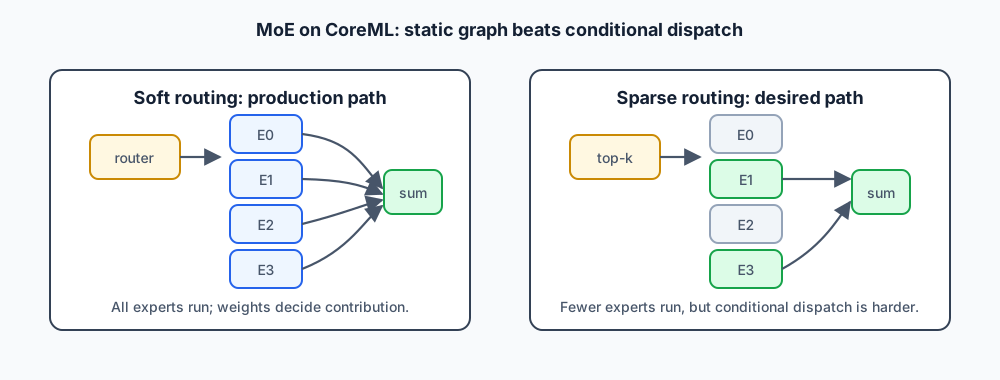
Approach 1: Soft Routing (Weighted Sum of All Experts)
Instead of conditionally dispatching, run ALL experts and compute a weighted sum where non-selected experts have weight 0:
# All 8 expert outputs
expert_outs = [experts[i](x) for i in range(n_experts)]  # 8 × [1, d_model, T, 1]

# Router weights for each expert (from softmax)
router_weights = router(x)  # [1, n_experts, T, 1] or [n_experts] for T=1

# Weighted sum
out = sum(w_i * e_i for w_i, e_i in zip(router_weights, expert_outs))
Pros: Fully vectorized. All experts run every step. Simple CoreML graph. Cons: 4× compute vs top-2 sparse routing (8 experts run vs 2 used).
Some variants explicitly mask the router to top-k before the weighted sum. Other variants use the full softmax distribution and rely on the inactive experts being near-zero. The ANE tradeoff is the same in both cases: the graph runs every expert so the compiled program has no data-dependent branch.
This is the approach used in ZAYA1-8B’s production CoreML shards. At 9 tok/s on M4 Max with 8 experts, the overhead is acceptable and the graph stays fully ANE.
The key: soft routing keeps the compute graph static (no dynamic branches),
which is what CoreML requires. CoreML has no if — only tensor operations.
Approach 2: Per-Expert Functions with Public Multi-Function Models
CoreML 9 introduced MLMultiFunctionDescriptor, the public API for calling a
specific procedure in a multi-function model:
let descriptor = MLMultiFunctionDescriptor(functionName: "expert_3")
let config = MLModelConfiguration()
config.functionName = "expert_3"
let model = try MLModel(contentsOf: expertPackageURL, configuration: config)
The public idea is that one package can expose multiple callable functions, so a runtime can choose one expert function without shipping eight separate packages.
Build a multi-function expert package:
# Build one mlpackage with N expert functions
# Each function is one expert's FFN
# coremltools 9 supports MLMultiFunction via custom MIL programs
This approach could enable sparse routing (only K of N experts run per step) at the cost of implementation complexity. The missing piece is not the router math; it is a public, efficient way to select expert functions per token while keeping intermediate activations device-local.
Status: not in production in this repo. The shipping ZAYA path uses static
soft routing because it is public CoreML, easy to validate with MLComputePlan,
and reliable on current tooling.
ZAYA1-8B Architecture
ZAYA is a 1.58-bit-average-binarized model trained from LLaMA-2-7B using “1-bit” techniques. Our CoreML port is the first ANE-native MoE of this class.
Variant note: this chapter describes the 8-expert, 28-layer ZAYA book/runtime
variant documented in models/zaya/README.md. The checked-in
converters/zaya_full_convert.py file is an Exp 34 RangeDim exporter for a
different ZAYA artifact family: H=2048, 16 experts plus one null router slot,
and MoE layers 1,3,...,79 (40 MoE shards). Do not use that converter as the
source of truth for the dimensions in this section without also adopting that
Exp 34 manifest family.
Key dimensions:
- 28 MoE layers
- 8 experts per layer, top-2 routing
d_model=4096,n_heads=32,n_kv_heads=8,d_head=128- Per-expert FFN:
d_model × d_ff/n_experts × d_model(soft-routed) - Embedding:
vocab_size × d_model= 32000 × 4096
Shard structure (58 compiled model shards):
zaya_ane/
├── attn/          # 28 attention shards (one per layer)
├── moe/           # 28 MoE FFN shards (one per layer, all 8 experts inside)
├── lm_head/       # 2 vocabulary-half shards
├── zaya_embed.bin # float16 embedding matrix
└── zaya_runtime_meta.json
Each attention shard: [1, d_model, T, 1] → attention + residual → [1, d_model, T, 1]
Each MoE shard: [1, d_model, T, 1] → router + 8 experts soft-sum + residual → [1, d_model, T, 1]
Packing All Experts Into One Shard
For ZAYA, all 8 expert FFNs are packed into a single .mlpackage per layer.
The packed MoE FFN:
class MoEFFN(nn.Module):
    def __init__(self, d_model, d_ff, n_experts):
        super().__init__()
        # All experts as Conv2d, stacked
        self.gate_projs = nn.ModuleList([
            nn.Conv2d(d_model, d_ff, 1, bias=False) for _ in range(n_experts)
        ])
        self.up_projs   = nn.ModuleList([...])
        self.down_projs = nn.ModuleList([...])
        self.router     = nn.Conv2d(d_model, n_experts, 1, bias=False)

    def forward(self, x):
        # Router: [1, n_experts, T, 1]
        router_logits = self.router(x)
        router_weights = torch.softmax(router_logits, dim=1)

        # All 8 experts (soft routing)
        out = torch.zeros_like(x)
        for i, (gate, up, down) in enumerate(zip(self.gate_projs, self.up_projs, self.down_projs)):
            expert_out = down(torch.nn.functional.silu(gate(x)) * up(x))
            w = router_weights[:, i:i+1, :, :]  # [1, 1, T, 1]
            out = out + w * expert_out

        return out
The loop over 8 experts is unrolled by TorchScript tracing — CoreML sees 8 × (gate + up + down + silu + mul + add) = 24 conv ops per MoE shard. All land on ANE.
Privacy Filter: MoE NER
The Privacy Filter is a different MoE application: Named Entity Recognition for PII detection. Model: ~1.5B parameters, 8 MoE experts, specialized for identifying names, phone numbers, emails, addresses.
Key differences from ZAYA:
- Output is token labels (BIO tags), not next-token logits
- Soft routing is a hard requirement (all entities must be detected, no sampling)
- End-to-end Swift wrapper handles BIO → span extraction → redaction
Performance: ~24.6 sentences/sec on M4 Max.
See models/privacy-filter/ for build scripts.
Sparse Routing: What a Public Path Would Need
Sparse MoE remains the enticing path because top-2 routing should run only two experts instead of all eight. To make that work cleanly through public CoreML, the runtime needs three properties:
- per-token selection of expert functions without recompiling or reloading;
- device-local intermediates between router, experts, and weighted sum;
MLComputePlanvisibility so residency can be validated before benchmarking.
Those requirements explain why this repo currently ships soft routing. It burns extra expert compute, but the graph is static, auditable, and portable across the public CoreML toolchain. Sparse routing is still a good future target once the public multi-function workflow is mature enough for this use case.
Checklist
[ ] Soft routing graph has no conditional branches (pure tensor math)
[ ] All expert ops land on ANE (MLComputePlan: 100%)
[ ] Cosine vs PyTorch golden ≥ 0.97 (routing weights may amplify small errors)
[ ] MoE shard size: 8 experts × per-expert MB ≤ 200 MB total
[ ] If packing > 8 experts: verify ANEF doesn't hit error -14
[ ] For Privacy Filter: BIO output validated on PII examples