Chapter 3 — Quantization on ANE
Quantization shrinks model weights. During decode, the runtime repeatedly loads large projection matrices to produce one new token, so smaller weights can reduce memory bandwidth pressure and improve tokens per second.
That benefit only counts if two gates still pass:
- Residency: the quantized graph must stay on ANE.
- Quality: the quantized output must stay close to the FP16 reference.
This chapter is about the tension between those gates. A quantization format can look attractive on paper and still fail because CoreML lowers it into an op pattern the ANE compiler rejects, or because small numerical errors accumulate through many layers.
The Only Safe Baseline: INT8 Per-Tensor
After 35+ experiments across five model families, the only quantization format
validated to keep all ios18.conv ops on ANE across all shard sizes is:
INT8 per-tensor weight quantization (
granularity="per_tensor")
Everything else either degrades quality, silently falls to CPU, or both.
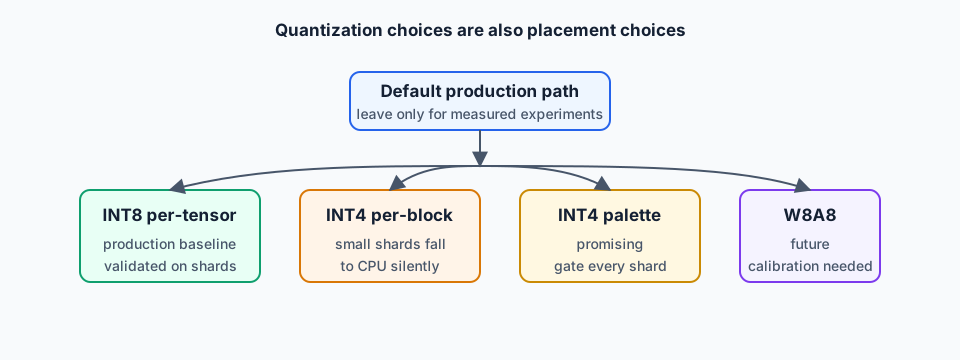
The INT4 Per-Block Silent CPU Fallback
This is the most dangerous failure mode in ANE development: your model compiles, loads, produces correct output — but runs entirely on CPU. No error. No warning.
Reproduction: Apply constexpr_blockwise_shift_scale (linear INT4 per-block)
to any small shard (2–8 transformer layers). Run MLComputePlan. Every
ios18.conv will show preferredComputeDevice == .cpu.
Measured evidence:
| Model | Layers | Quant | Conv placement | CPU ops |
|---|---|---|---|---|
| Qwen 0.5B (non-stateful) | 24 | INT4 per-block | 97/97 CPU | 3059 |
| Qwen 1.5B shard | 3 | INT4 per-block | 12/12 CPU | 66 |
| Qwen 3B shard | 2 | INT4 per-block | 8/8 CPU | 48 |
| Qwen 3B shard | 2 | INT8 per-tensor | 8/8 ANE | 0 |
| Qwen 0.5B (stateful, 24L) | 24 | INT4 | 97/97 ANE | 0 |
The pattern: INT4 per-block + small graph → CPU. The ANEF cost model apparently needs a large enough op graph to justify scheduling INT4 dequantization on ANE. For shards (small subgraphs), it consistently bails.
INT8 per-tensor does not have this problem.
Why INT8 Works
INT8 per-tensor dequantization is a single multiply per weight tensor:
w_f32 = w_int8 * scale. The dequant + conv fusion is simple enough that the
ANE compiler handles it at all graph sizes.
INT4 per-block dequantization requires per-block scale lookups:
w_f32[i] = w_int4[i] * scale[i // block_size]
The extra indexing creates a pattern the ANEF cost model rejects for small graphs.
INT4 Palettization: Promising But Unvalidated
constexpr_lut_to_dense (4-bit palettization / codebook quantization) is a
different compression family from linear INT4 per-block. Do NOT conflate them.
Known from experiments:
- The Qwen 0.5B monolithic model with INT4 palettization (stateful) shows 97/97 ANE in one tested configuration.
- This result has not been replicated across smaller shards.
The hypothesis: palettization uses a table lookup rather than per-block scaling, which may fit the ANE’s fixed-function pipeline better. It remains a promising research direction but is not yet a validated production baseline.
INT4 Noise at 1.5B Scale
Even if INT4 lands on ANE, quality degrades at >1B parameter scale:
Qwen 1.5B, INT4 g32:
  ✓ "Capital of France?" → "Paris"
  ✗ "3 largest planets" → "Jupiter (mass: 1.111111111..."
  ✗ "Berlin Wall" → "November . . . . . . ."
This is quantization noise, not a bug. The wider layers at 1.5B (d=1536, dff=8960) accumulate more quantization error than the narrower 0.5B layers (d=896, dff=4864). Increasing block size from g32 to g64 did not help.
The minimum model scale where INT8 quality holds: any scale tested (0.5B to 8B). The minimum model scale where INT4 quality holds: ≤0.5B (narrow architectures only).
W8A8 (Weights + Activations): Future Direction
W8A8 quantizes both weights and activations to INT8. This can reduce bandwidth further but requires:
- Activation calibration data (a representative prompt set)
- Per-layer scale tuning
- A separate ANE residency audit (activations travel differently than weights)
Not yet validated. Do not use as a production path without the full gate sequence.
The Norm Convention Bug: A Case Study
On 2026-04-23, four hours of “INT4 quality cost” framing turned out to be a
one-line bug: RMSNorm (1+gamma) → gamma.
This case study comes from the author’s experiment log, not from a checked-in Gemma converter in this repository. Treat the specific Gemma date/model as provenance for the debugging lesson; the reproducible rule is the validation procedure below.
Gemma-4-26B-A4B uses w_eff = (1 + gamma) in its RMSNorm (a scalar offset).
Using raw gamma produces logits that are systematically shifted, mimicking
quantization noise. Cosine similarity in the 0.92–0.97 range against FP16 reference
is the signature.
Before blaming quantization quality, always verify:
- RMSNorm convention (
(1+gamma)vsgamma) - Embedding scale (
sqrt(d_model)vs1.0) - Softcap divisor location
- Residual stream dtype downcast point
INT8 noise on well-converted models yields cos > 0.999. Cos in 0.92–0.97 is a bug, not inherent quantization cost.
Quantization Decision Tree
Start with the production default:
  └── INT8 per-tensor. Validated across shard sizes.

Only leave the default for a measured compression experiment:
  └── Model < 1B params, monolithic (not sharded)?
    └── Try INT4 palettization (lut_to_dense). Run MLComputePlan.
  └── Sharded model?
    └── Stay on INT8 until INT4 palettization passes shard-level gates.
  └── INT4 per-block?
    └── Do not use for shards. It silently falls to CPU.
Checklist Before Using Any Non-INT8 Quantization
[ ] MLComputePlan check: 100% conv ops on ANE (not compile success)
[ ] Cosine similarity ≥ 0.97 vs FP16 golden
[ ] Tested on a shard of the actual planned size, not a monolithic model
[ ] Verified with the specific coremltools version you're using